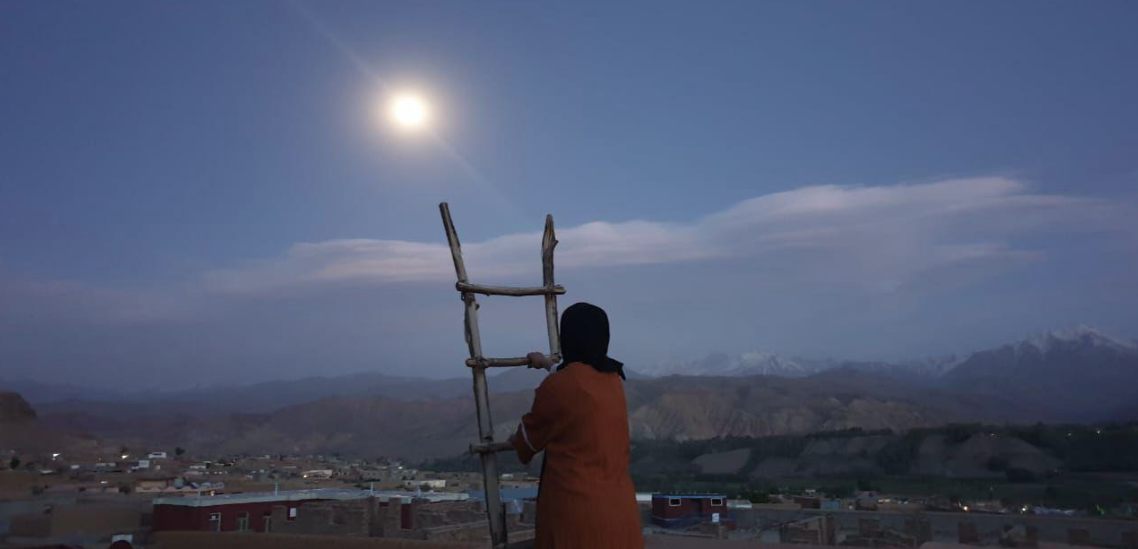
It was a cold, dry winter. Buda, with his wounded body, still watched over the city,
silent and steadfast. After work, I always took the path past him to reach my home.
There were shorter routes, but I chose that one just to see him. It felt like visiting an
old friend.
In Buda’s wounds, I saw my own. He had been targeted for standing firm, for bearing
witness to history, for representing a culture and knowledge long silenced.
In the days that followed, it felt as if Buda had lowered his head under the weight of
the world. Every time I passed him, I could not meet his gaze; I lowered mine too,
carrying a portion of his sorrow. The air seemed heavier, the streets quieter, and the
shadows longer. This was not what we had earned, not what we had fought for. We
had grown up believing in laughter, in festivals, in sunlight on the mountains and yet
here we were, walking past a silent witness to our loss, our hearts pressed down under
the weight of fear and grief.
For a few minutes, I stared at him, my chest tight. I had been forced to leave Kabul
after the Taliban took over. Fear followed us like a shadow, the nightmares of the
previous generation returning. The world seemed to have forgotten us. In the corners
of the city, bodies appeared, nameless and unattended, and no one claimed
responsibility for their deaths.
I loved Bamyan, the Potato Flower Festival, the Dambura music, the laughter of
people in Band-e Amir, but now, fear had taken root behind the eyes of children, and
in the gaze of the girls, I saw something like exhaustion and despair, far older than
their years.
Then I received a message.
"Zahra is gone."
I could not believe it. Zahra, with her deep laugh that could fill a room, her strength
and kindness, how could she no longer be here?
Our phone lines were not safe. I contacted another friend online. Her voice trembled
as she spoke. Zahra had been taken from her home days before by the Taliban,
accused of actions they deemed unacceptable. Her family searched frantically, going
from office to office, but all were denied access. After six days, the Taliban confirmed
they had her, and demanded her father pay 250,000 Afghanis as a fine. They also
forced a written promise that Zahra would not repeat the acts they condemned.
When Zahra finally returned home, she was not the same girl. Her mother watched
her closely, noticing every hesitation, every silence. The light in her eyes had dimmed,
the warmth in her smile was gone, and her movements carried a heaviness that had
not been there before. The girl who had left was fractured, carrying the weight of
what she had endured. When her mother asked her what had happened, Zahra would
only whisper,
"I am tired. I need to rest."
The quiet in her room was heavier than any words. Her suffering was visible in the
way she moved, the way she avoided gaze, and the heaviness in her breath. The light
in her eyes, so full of hope before, had dimmed.
And then she was gone. Zahra had taken her own life, her story carried with her.
I could not bring myself to attend her funeral. I was not brave enough to say goodbye.
I wept for a long time, and as the cold, sorrowful sun sank behind the mountains, I
stood before Buda and made a promise: I would tell her story. Now, my tears no
longer hold me back. I write for her, and for all those like her, hoping that even a
single reader might glimpse how we live here, the fear, the loss, and the quiet courage
that endures despite it all.
 S
S